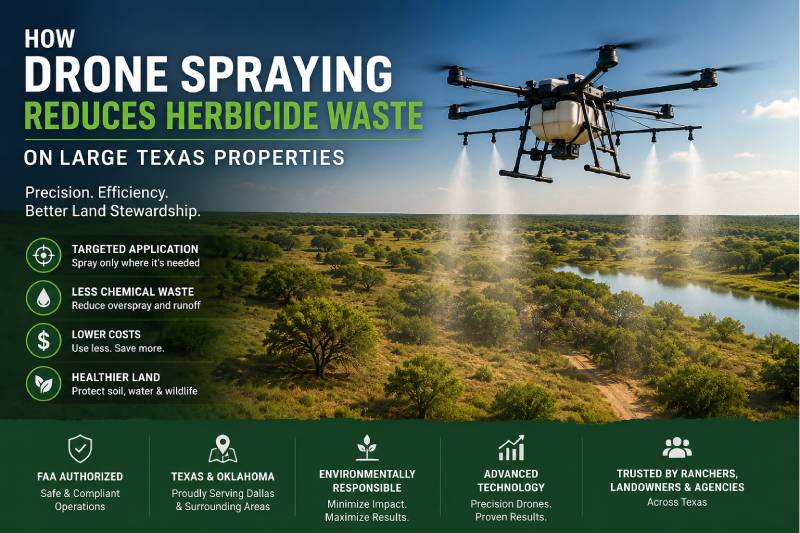
Managing vegetation across large Texas ranches, wildlife properties, and infrastructure corridors often requires herbicide applications to control invasive plants, woody brush, and unwanted aquatic vegetation. While herbicides remain an effective management tool, traditional application methods frequently result in unnecessary chemical waste, higher operational costs, and unintended environmental impacts.
Precision drone spraying is changing that approach.
Instead of applying herbicides across an entire field or property, drone technology delivers highly targeted applications exactly where treatment is needed. This allows landowners to control invasive vegetation while reducing chemical usage, protecting surrounding ecosystems, and lowering overall project costs.
If you manage large acreage in Texas, understanding how precision drone spraying works can help you make more informed land management decisions.
Why Herbicide Waste Is a Growing Challenge
Traditional ground equipment often applies herbicide over broad areas regardless of whether every section requires treatment.
Common causes of herbicide waste include:
- Blanket spraying
- Uneven terrain
- Equipment overlap
- Wind drift
- Human error
- Difficult-to-reach areas
These issues increase chemical costs while potentially affecting desirable vegetation, wildlife habitats, and nearby waterways.
How Precision Drone Spraying Works
Modern agricultural and land management drones combine GPS navigation, terrain-following radar, and programmable flight paths to apply herbicides with exceptional precision.
GPS Flight Planning
Each mission begins with mapping the treatment area to create highly accurate flight paths.
This eliminates unnecessary overlap while ensuring complete coverage.
Terrain Following
Unlike traditional boom sprayers, drones automatically adjust their height over uneven terrain.
This maintains consistent spray accuracy even on:
- Hillsides
- Creek banks
- Levees
- Watersheds
- Remote ranch properties
Targeted Application
Instead of spraying every acre equally, drones focus treatment only where invasive vegetation exists.
This dramatically reduces herbicide waste.
Why Traditional Spraying Uses More Herbicide
Ground equipment remains valuable for certain applications, but several limitations contribute to increased chemical consumption.
Heavy equipment often:
- Covers non-target vegetation
- Creates overlapping spray patterns
- Cannot access steep or wet terrain
- Requires larger treatment zones
These inefficiencies increase both environmental impact and operating costs.
Five Ways Drone Spraying Reduces Herbicide Waste
1. Precision Targeting
Drone operators treat only invasive or undesirable vegetation rather than the surrounding landscape.
This minimizes unnecessary herbicide application.
2. Reduced Overspray
GPS-guided flight paths produce consistent coverage with minimal overlap.
Every gallon of herbicide is applied where it provides the greatest benefit.
3. Improved Coverage
Drone technology easily reaches:
- Dense brush
- Shorelines
- Levees
- Wetlands
- Remote terrain
without disturbing the surrounding land.
4. Lower Overall Chemical Usage
Because drones avoid blanket spraying, many projects require significantly less herbicide than conventional methods.
Reduced chemical use also means lower purchasing costs and fewer environmental concerns.
5. Better Environmental Protection
Precision applications help preserve:
- Native grasses
- Trees
- Wildlife habitats
- Pollinator areas
- Sensitive aquatic ecosystems
This supports healthier long-term land management.
Real Benefits for Texas Landowners
Across Texas, drone spraying is helping:
- Ranch owners
- Municipal agencies
- Watershed authorities
- Wildlife managers
- Infrastructure operators
achieve vegetation control more efficiently.
Benefits include:
- Lower chemical waste
- Faster project completion
- Reduced soil disturbance
- Improved worker safety
- Better access to difficult terrain
When Drone Spraying Is the Best Solution
Drone vegetation management is particularly effective for:
- Large ranches
- Aquatic vegetation control
- Mesquite management
- Brush control
- Utility corridors
- Wildlife habitat improvement
- Dam and levee vegetation
- Invasive species management
Why Choose Higher Ground Aerial?
Higher Ground Aerial combines FAA-authorized drone operations with licensed herbicide application to deliver safe, efficient, and environmentally responsible vegetation management throughout Texas and Oklahoma.
Our precision approach helps clients:
- Reduce chemical waste
- Improve land health
- Protect wildlife habitats
- Lower operational costs
- Reach areas inaccessible to traditional equipment
Whether you’re managing a ranch, watershed, wildlife preserve, or public infrastructure, our team provides customized aerial vegetation management solutions designed for your property’s unique needs.
Conclusion
Reducing herbicide waste isn’t just about lowering chemical costs—it’s about improving land stewardship.
Precision drone spraying provides a smarter, more sustainable approach to vegetation management by delivering herbicides exactly where they are needed while minimizing environmental impact.
For Texas landowners looking to improve efficiency without compromising results, drone technology has become one of the most effective tools available.
If you’re planning a vegetation management project, contact Higher Ground Aerial to learn how precision drone spraying can help protect your land while reducing unnecessary herbicide use.
Internal Linking Strategy
Use these anchor texts naturally throughout the article:
- Aerial Vegetation Management in Texas
- brush control services for ranches
- wildlife habitat management solutions
- Contact Higher Ground Aerial
- aquatic vegetation management services
- drone mapping and land assessment
FAQ Section
Does drone spraying use less herbicide than traditional methods?
Yes. Precision drone spraying targets only the vegetation requiring treatment, significantly reducing overspray and unnecessary chemical use.
Is drone herbicide spraying environmentally friendly?
Drone spraying minimizes chemical drift, reduces soil disturbance, and protects surrounding vegetation and wildlife habitats when performed by licensed operators.
What types of properties benefit most from drone spraying?
Large ranches, wildlife properties, watersheds, utility corridors, levees, wetlands, and conservation areas benefit significantly from drone vegetation management.
Can drone spraying reach difficult terrain?
Yes. Drone technology is ideal for steep slopes, wetlands, creek banks, heavily wooded areas, and locations that are unsafe or inaccessible for traditional ground equipment.
SUGGESTED INTERNAL LINKS