If you manage land in Texas or Oklahoma, you’ve probably noticed a shift happening across the region. Drones are no longer just for photography — ag drone spraying is now a legitimate, proven alternative to conventional ground-based equipment, and landowners across both states are taking notice.
Still, is it right for your property? The honest answer: it depends. In this post, we’ll break down the real differences between ag drone spraying and traditional equipment so you can make an informed decision based on your land, your goals, and your budget.
What Is Ag Drone Spraying?
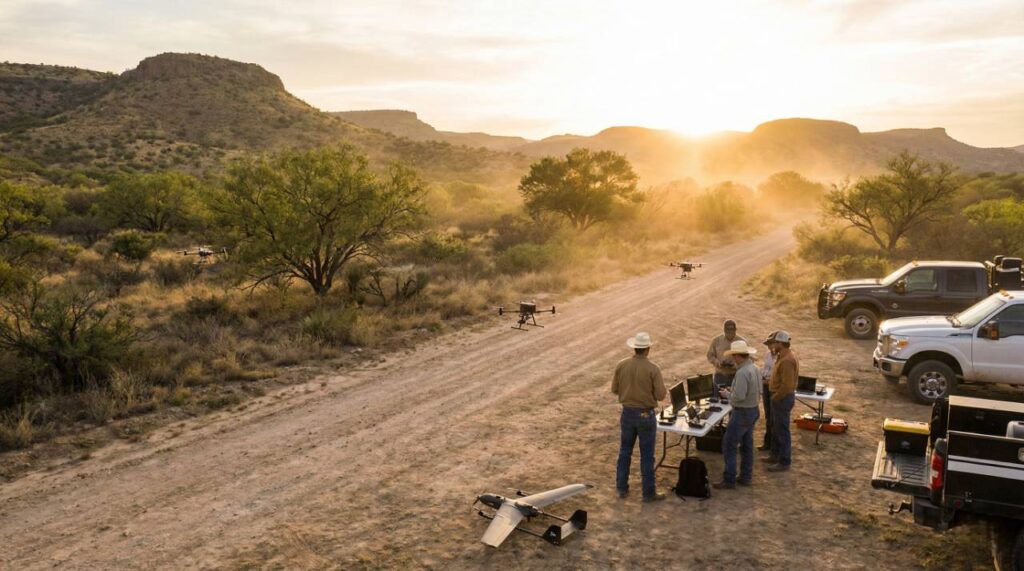
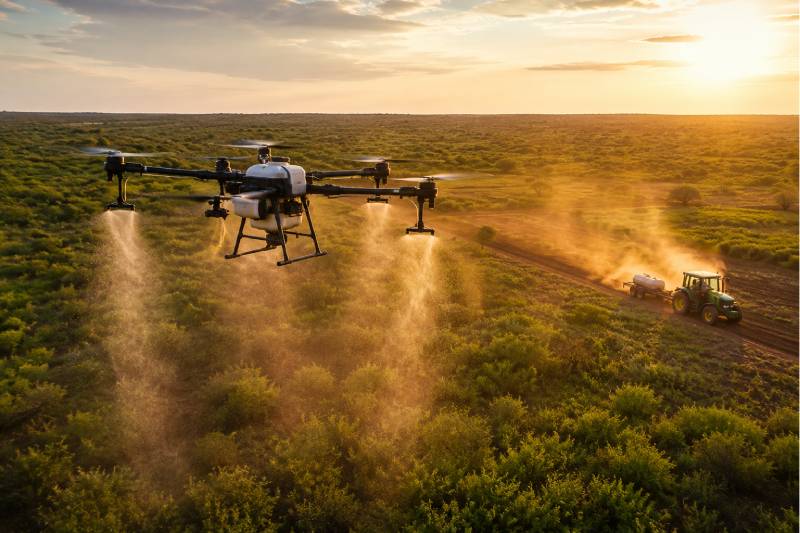
Ag drone spraying uses GPS-guided unmanned aerial vehicles (UAVs) equipped with liquid tanks and precision nozzles to apply herbicides, pesticides, or fertilizers across a property. Specifically, these drones fly low — typically 6 to 15 feet above the vegetation — and deliver a targeted, controlled spray pattern with minimal drift.
Here at Higher Ground Aerial, our drone systems are designed specifically for land and wildlife management across Texas and Oklahoma — handling everything from brush control to invasive species treatment.
What Is Traditional Spraying Equipment?
Traditional equipment includes ground-based options like boom sprayers mounted on tractors, ATVs, pickup trucks, or dedicated spray rigs. In addition, aerial crop dusters and helicopters also fall into the “conventional” category for large-scale ag operations.
Overall, these methods have been the industry standard for decades and work well in many scenarios — however, they are generally limited to flat, open, accessible land with few obstacles.
Head-to-Head Comparison
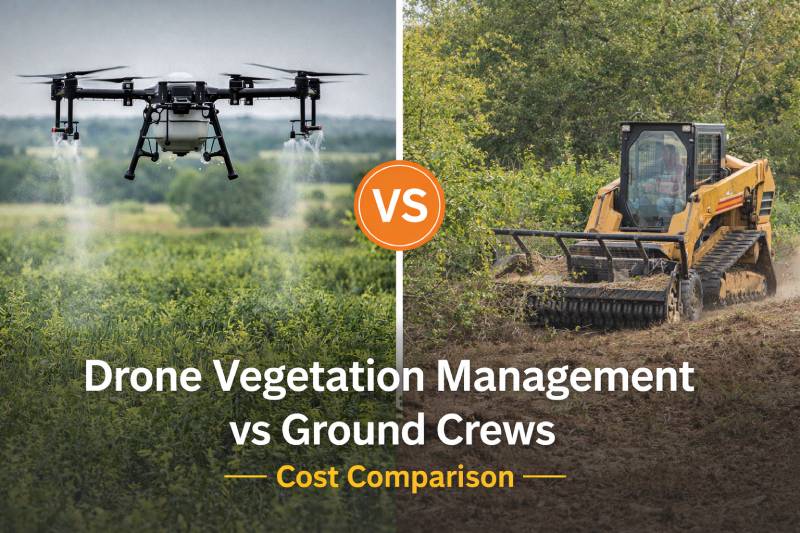
To help you make a clear decision, here’s how the two methods stack up across the factors that matter most to Texas and Oklahoma landowners:
| Factor | Ag Drone Spraying | Traditional Equipment |
| Terrain Access | Handles rough, hilly, wet, or wooded terrain easily | Limited by ground conditions and accessibility |
| Chemical Precision | Highly targeted — reduces waste by up to 30–50% | Broader application, higher drift risk |
| Setup Time | Quick deployment, minimal setup | Equipment prep, calibration, field access required |
| Cost Per Acre | Competitive for complex terrain; higher for flat open fields | Lower per-acre cost on large, flat, open acreage |
| Crew Size Needed | Small team (1–2 operators) | Larger crew or multiple passes often required |
| Environmental Impact | Lower chemical use, reduced soil compaction | Higher chemical volume, potential soil disruption |
| Ideal Property Size | Best for 5–500+ acres with obstacles or slopes | Most cost-effective on large, flat, open acreage |
| Speed | Up to 50 acres/hour depending on terrain | Varies; slower in complex terrain |
When Drone Spraying Wins
In particular, drone spraying is the clear choice when terrain makes ground access difficult or impossible. Rugged, uneven land — including steep hillsides, rocky ridges, and dense cedar or mesquite thickets — simply blocks tractors and ATVs from getting the job done. Beyond terrain, wetlands, creek bottoms, and flood-prone areas that become inaccessible after rain are no obstacle for a GPS-guided UAV. Properties where soil compaction is a concern also benefit greatly, since drones leave zero ground disturbance behind. For targeted needs like invasive species control, selective weed treatment, or protecting wildlife habitat from unnecessary disruption, precision drone application is hard to beat. As a result, drone spraying is often the only viable option for landowners managing complex or mixed terrain — which covers a large portion of Texas and Oklahoma ranching country.
When Traditional Equipment Wins
On the other hand, traditional equipment still makes strong sense in the right conditions. Large-scale operations covering thousands of acres of flat, open, cleared farmland are where ground rigs genuinely shine — especially if you already own the equipment and have trained operators on staff. Broad, uniform treatments that require no obstacle avoidance are also a natural fit, particularly when open field conditions eliminate any concern about aerial drift. In short, if your land is flat, accessible, and you’re already equipped — traditional methods may still be your most cost-efficient route.
The Real Cost Question
Many landowners assume traditional equipment is always the cheaper option. However, that’s not necessarily true once you factor in the full picture. Equipment purchase, maintenance, and storage costs add up quickly, and fuel and labor for multiple passes can push the per-acre price higher than expected. Imprecise application also leads to chemical waste, while difficult terrain can cause costly downtime — and repeated heavy machinery use risks long-term soil and vegetation damage. Ultimately, when you add all those costs together, hiring a professional drone spraying service — especially for complex Texas and Oklahoma terrain — often comes out ahead financially, while delivering better, more consistent results.
What About a Hybrid Approach?
Interestingly, many landowners we work with don’t choose one method exclusively — instead, they use both strategically. For example, ground equipment handles wide-open pasture areas, while drones tackle creek bottoms, rocky ridges, and dense brush zones. This hybrid approach gives you the efficiency of both technologies where each performs best, ultimately maximizing coverage and minimizing cost.
Frequently Asked Questions
Q1: How much does ag drone spraying cost per acre in Texas?
Costs typically range from $8 to $20 per acre depending on terrain complexity, chemical type, and acreage. That said, this may seem higher than traditional equipment on flat land — but the savings in chemical waste, labor, and equipment maintenance often make drone spraying more cost-effective overall. In particular, properties with rugged or hard-to-access terrain tend to see the greatest return on investment.
Q2: How many acres can a drone spray in a day?
A professional ag drone setup can cover 200–400+ acres per day depending on the drone model, tank capacity, terrain, and application rate. However, on complex or hilly terrain, expect a slightly lower output compared to open flat fields. In addition, multiple drones can be deployed simultaneously on larger properties to significantly increase daily coverage.
Q3: Is drone spraying as effective as traditional sprayers?
Yes — and in many cases, more so. Drone spraying delivers precise, targeted application directly to the plant canopy, reducing chemical drift and waste by up to 30–50%. In fact, for invasive species control and selective treatments, drones often outperform ground equipment entirely. As a result, many Texas landowners are seeing better vegetation control outcomes with fewer chemical inputs.
Q4: Can drones spray herbicides on steep or rocky terrain?
Absolutely — and this is one of the biggest advantages of drone spraying. Steep hillsides, rocky ridges, creek bottoms, and dense brush are no obstacle for a GPS-guided UAV. Furthermore, because the drone operates aerially, there is zero risk of equipment rollover or operator injury on difficult terrain. Tractors and ATVs simply cannot access those same areas safely.
Q5: Do I need to be home when the drone spraying takes place?
Not necessarily. Higher Ground Aerial’s team handles the full operation independently — from access coordination to post-treatment reporting. Additionally, a detailed summary of everything covered will be sent to you once the job is complete, so you always know exactly what was treated and where.
Q6: Is ag drone spraying safe for wildlife and livestock?
When conducted by certified professionals using the correct herbicide or pesticide formulations, drone spraying is safe for wildlife and livestock. Because drones apply chemicals precisely and at lower volumes than traditional methods, environmental exposure is significantly reduced. Moreover, label requirements are always followed to the letter. As a precaution, temporary livestock removal during treatment is recommended as a standard best practice.
Q7: What areas does Higher Ground Aerial serve?
Higher Ground Aerial provides ag drone spraying and land management services across Texas and Oklahoma, including rural ranches, wildlife preserves, large private landholdings, and agricultural operations. In addition to spraying services, the team also offers aerial mapping, vegetation management, and habitat assessment for landowners across both states.
Not Sure Which Method Is Right for Your Property?
Higher Ground Aerial serves landowners across Texas and Oklahoma with professional drone spraying and land management services. To that end, we’ll evaluate your property, your goals, and your terrain — and give you an honest recommendation, even if that means telling you traditional equipment is the better fit.
So, contact us today for a free consultation and property assessment. Let’s figure out what actually works best for your land.
SUGGESTED INTERNAL LINKS