
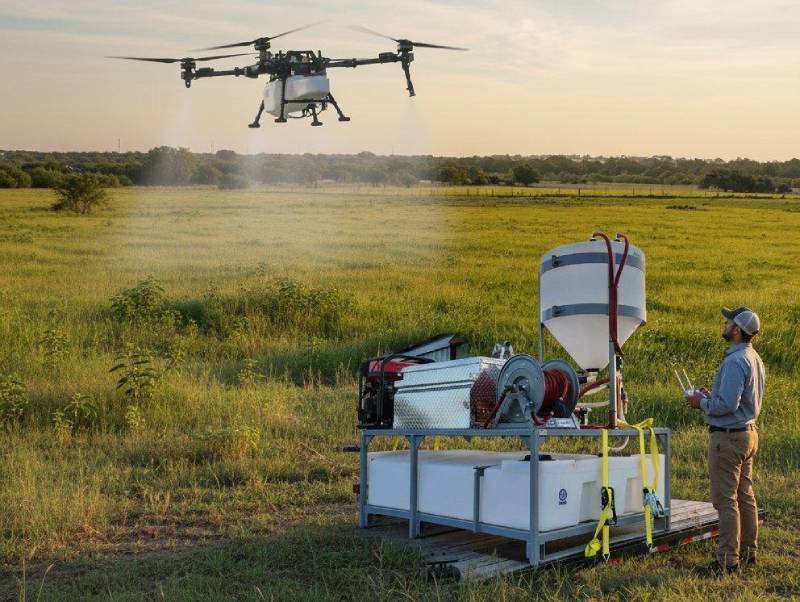
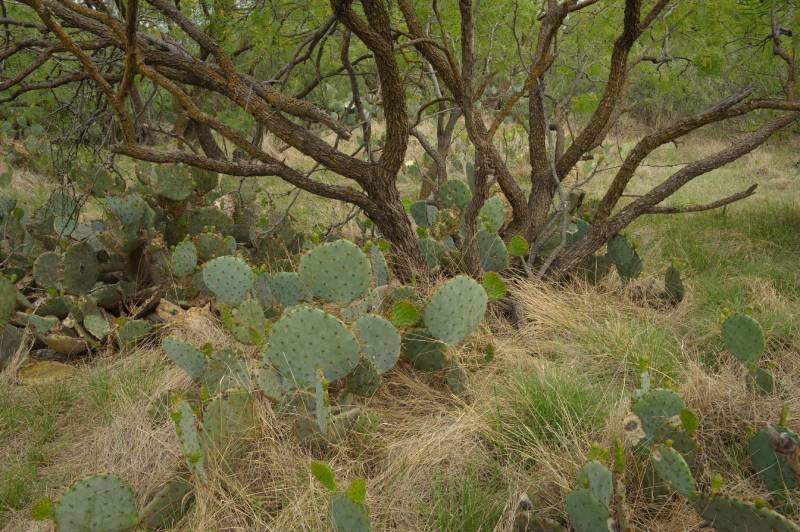
Mesquite trees and prickly pear cactus are common across Texas rangelands, but when they spread into the wrong areas, they can make ranch management more difficult. Dense growth may interfere with livestock movement, reduce access to parts of a property, compete with desirable forage, and complicate long-term vegetation management.
Effective mesquite and prickly pear control starts with understanding where these plants are causing problems, identifying the right treatment approach, and planning for follow-up monitoring. For large ranches, targeted ground treatments and professional aerial vegetation management may each have a role, depending on plant density, terrain, property objectives, and application requirements.
Higher Ground Aerial Land and Wildlife helps Texas and Oklahoma landowners manage unwanted vegetation through precision aerial treatment and land-management solutions designed around site conditions.
Why Mesquite and Prickly Pear Can Become a Ranch Management Problem
Mesquite and prickly pear are adapted to the challenging conditions found across much of Texas. Both can persist in dry environments, making them difficult to manage when their growth begins to conflict with a property’s intended use.
However, neither plant should automatically be considered undesirable everywhere. The goal is to manage vegetation according to the needs of the ranch.
Mesquite: Managing Expanding Brush
Mesquite can become a significant brush-management concern when it spreads across pastures, grazing areas, access routes, and other areas where landowners need to maintain productive vegetation.
Potential problems include:
- Reduced grazing access: Dense woody growth can make some areas harder for livestock to reach and use.
- Competition with desirable plants: Expanding brush can compete with grasses and other vegetation for available resources.
- More complicated maintenance: Areas with established mesquite may require a more deliberate, long-term management plan.
- Restricted property access: Dense growth can interfere with movement across portions of a ranch.
Texas A&M AgriLife Extension provides mesquite-specific guidance covering individual-plant treatment methods and broader management considerations. Its resources emphasize selecting control methods according to plant characteristics and treatment objectives.
Prickly Pear: Controlling Unwanted Cactus Growth
Prickly pear is also a familiar feature of Texas rangelands. It can provide food for wildlife and may serve as supplemental forage for livestock during some dry periods. However, dense colonies can interfere with livestock movement and handling, reduce forage utilization, and compete with desirable plants.
Landowners may need to consider prickly pear control when cactus growth:
- Expands into frequently used grazing areas.
- Interferes with livestock handling or movement.
- Occupies areas intended for forage production.
- Spreads along access routes or around managed pasture areas.
- Becomes difficult to manage through occasional maintenance alone.
The appropriate response depends on the property’s objectives. Selective control may be preferable where some cactus is beneficial, while heavier infestations may require a different treatment strategy.
How to Decide Whether Your Ranch Needs Mesquite or Cactus Control
Before selecting a treatment, identify the problem you are trying to solve. A ranch managed primarily for livestock may have different priorities from a property managed for wildlife, recreation, or a combination of uses.
Consider the following questions:
1. Where is the vegetation concentrated?
Map the affected pastures, brush patches, cactus colonies, access routes, and other priority areas. Identifying the location and extent of the problem helps determine whether individual-plant treatment, targeted aerial application, or a combination of methods deserves consideration.
2. How dense and established is the growth?
Scattered plants may be manageable with selective treatment. Dense infestations can require a more comprehensive plan, and established plants may respond differently from young growth.
3. What should the land support after treatment?
Decide whether the priority is improved grazing access, more usable acreage, targeted brush suppression, habitat management, or a combination of goals. This decision helps determine which vegetation should be controlled and which should remain.
4. Are there sensitive areas or access limitations?
Steep slopes, wet ground, uneven terrain, and areas that are difficult to reach with equipment may influence the treatment method. These are situations where aerial treatment may be worth evaluating.
5. How will results be monitored?
A treatment plan should include a way to revisit the site, assess the response of the target plants, and identify regrowth or new seedlings.
Mesquite and Prickly Pear Control Methods
There is no single treatment that fits every ranch. The best option depends on the target species, plant density, property conditions, land-use objectives, and the products and methods permitted for the site.
1. Individual-Plant Treatment
Individual-plant treatment focuses on specific plants instead of treating an entire area. Depending on the species and conditions, this may involve targeted herbicide application or mechanical removal.
Texas A&M AgriLife Extension’s Brush Busters resources describe selective methods for mesquite and prickly pear. These approaches can be useful when unwanted plants are relatively scattered and landowners want to retain desirable vegetation nearby.
Individual treatment may be appropriate for:
- Smaller infestations.
- Scattered plants in priority areas.
- Follow-up control after broader treatment.
- Locations where selective plant removal is the primary objective.
Its practicality can decrease when plant numbers, acreage, or access requirements make treating each plant individually too time-consuming.
2. Mechanical Brush or Cactus Removal
Mechanical methods physically cut, remove, or disturb unwanted vegetation. Their suitability depends on the terrain, plant size, density, soil conditions, and the equipment required.
Mechanical removal may be considered when physical clearing is necessary or when the project requires a result that herbicide treatment alone cannot provide.
However, equipment access, soil disturbance, erosion concerns, debris handling, and the risk of spreading cactus pads should be considered during planning.
For example, Texas A&M AgriLife Extension notes that detached prickly pear pads can root when they come into contact with the ground. Handling and disposing of removed material appropriately is therefore important.
3. Aerial Vegetation Treatment Using Drones
For certain large ranches and difficult-to-access areas, professional drone-based vegetation treatment can provide another option.
Aerial application allows trained operators to reach designated treatment areas without driving heavy equipment through the entire site. This can be useful when access, terrain, or the need to minimize ground disturbance influences the project.
Depending on the vegetation and approved treatment plan, aerial services may be worth evaluating for:
- Large or difficult-to-access treatment areas.
- Unwanted brush in designated pasture sections.
- Areas where ground equipment access is challenging.
- Properties requiring targeted vegetation management across multiple zones.
- Follow-up work as part of a longer-term land-management program.
A drone is not automatically the best solution for every mesquite or cactus infestation. Application suitability depends on the plant, its growth stage and density, the terrain, weather, the treatment objective, and the applicable product label and regulations.
Where individual-plant treatment or mechanical removal is more appropriate, those methods should remain part of the decision.
Higher Ground Aerial provides mesquite control and cactus control solutions as part of its broader aerial vegetation management services across Texas and Oklahoma.
How to Plan a Targeted Mesquite and Cactus Management Program
A well-planned program should focus on the areas that matter most to the property rather than treating every acre identically.
Step 1: Assess the Property
Identify the affected vegetation, estimate the area involved, and document access limitations. Aerial imagery or mapping may help land managers understand where infestations are concentrated and establish priorities.
Step 2: Set Clear Management Objectives
Determine what success should look like. Examples include improving livestock access, managing brush in selected pasture areas, reducing unwanted cactus growth, or maintaining a defined vegetation pattern.
Wildlife properties may need to retain specific brush and cactus patches for food or cover. Complete removal is not necessarily the right objective.
Step 3: Select the Appropriate Treatment
Compare selective treatment, mechanical options, and professional aerial application based on the species, density, terrain, desired outcome, and site constraints.
Herbicide selection and application must follow the applicable product label, including permitted sites, rates, application methods, weather restrictions, and grazing or other use restrictions.
Step 4: Schedule Treatment Carefully
Treatment timing can influence results. Plant growth, moisture, weather, and the selected application method all matter. A qualified vegetation-management provider can help evaluate the appropriate timing and treatment requirements for the specific site.
Step 5: Monitor and Follow Up
Do not assume that one treatment will permanently eliminate the problem. Mesquite can regrow or re-establish, and prickly pear can spread through seeds and detached pads. Texas A&M AgriLife Extension specifically recommends monitoring treated areas and addressing unwanted new growth.
A follow-up plan helps landowners evaluate treatment results, identify remaining problem areas, and decide whether additional control is necessary.
Why Long-Term Monitoring Matters
Vegetation management is an ongoing land-management task. Even when a treatment produces the desired initial result, the property may require future inspections and selective follow-up.
For mesquite, monitoring can help identify new seedlings and areas where brush is returning. For prickly pear, landowners should watch for new plants and pads that have rooted in suitable locations.
A practical monitoring program can include:
- Keeping records of treated areas and dates.
- Photographing priority locations before and after treatment.
- Revisiting sites to assess the response of target vegetation.
- Recording areas where new growth appears.
- Updating the treatment plan as land-use goals change.
This approach gives ranch managers a clearer picture of what is working and where further attention may be needed.
Can Aerial Treatment Support Wildlife and Grazing Goals?
Yes, in suitable situations—but the treatment plan must reflect the property’s specific objectives.
Ranch vegetation can serve several purposes at once. Some plants compete with desired forage or obstruct access, while others provide food, shelter, or cover for wildlife.
For that reason, effective management is not simply about removing as much vegetation as possible. It is about deciding where control is necessary and where vegetation should remain.
Targeted aerial treatment may help land managers address selected problem areas while minimizing equipment movement through the site. The appropriate treatment pattern should be planned around the property’s grazing, habitat, access, and conservation priorities.
For properties with wildlife-management goals, explore Higher Ground Aerial’s wildlife habitat improvement and land-management services.
When Should You Contact a Professional Vegetation Management Provider?
Consider a professional assessment if:
- Mesquite or prickly pear is spreading across large portions of your property.
- Dense vegetation is making livestock access or pasture management more difficult.
- Terrain or wet ground limits access for conventional equipment.
- You need to prioritize treatment across multiple areas of a large ranch.
- You want to combine vegetation control with longer-term habitat or land-management objectives.
- Previous treatment has not delivered the expected results.
A site-specific assessment can help determine which areas need attention, which methods are appropriate, and whether aerial treatment is a suitable option.
Mesquite and Prickly Pear Control for Texas Ranches: A Practical Approach
Mesquite and prickly pear are part of the Texas landscape, but unmanaged growth can create challenges when it conflicts with grazing, access, or property-management goals.
The most effective approach begins with identifying the problem, deciding what the land needs to support, selecting an appropriate treatment method, and monitoring results over time.
For large properties and areas that are difficult to reach, professional drone-based vegetation management may offer a useful addition to the landowner’s available options.
Higher Ground Aerial Land and Wildlife provides aerial vegetation management, mesquite control, and cactus control solutions across Texas and Oklahoma. If unwanted vegetation is affecting your ranch, contact the team to discuss your property, treatment priorities, and available options.
Request a vegetation management assessment or call (214) 744-3647 to discuss your land-management needs.
Frequently Asked Questions
How do you control mesquite on a Texas ranch?
Mesquite control options include selective individual-plant treatment, mechanical methods, and appropriate professional herbicide applications. The right approach depends on plant size and density, acreage, terrain, land-use goals, and the treatment method permitted for the site.
What is the best way to control prickly pear cactus on ranch land?
The best method depends on how densely the cactus is growing and what the landowner wants to achieve. Selective individual-plant treatment may suit scattered plants, while heavier infestations may need a broader management strategy. Any treatment should account for desirable vegetation and the possibility that detached pads can root.
Can drones be used for mesquite and cactus control?
Professional drones can be used for certain aerial vegetation treatments when the target plants, application method, product label, site conditions, and applicable regulations allow it. An assessment is needed to determine whether aerial treatment is suitable for a particular ranch.
Is drone vegetation treatment suitable for large Texas ranches?
It may be suitable for large properties, designated treatment areas, and locations where ground access is difficult. Suitability depends on vegetation density, terrain, the treatment objective, and the operational and regulatory requirements of the project.
Does one mesquite or prickly pear treatment permanently solve the problem?
Not necessarily. New plants, regrowth, seeds, and detached cactus pads can lead to renewed growth. Monitoring and follow-up treatment may be needed as part of a long-term vegetation-management plan.
Should all mesquite and prickly pear be removed from a ranch?
No. The right amount of vegetation depends on the property’s goals. Some cactus and brush can provide food or cover for wildlife, and some vegetation may be valuable to the overall land-management plan. Control should focus on areas where growth conflicts with the intended use of the land.
How can I get a quote for mesquite or cactus control in Texas?
Start by sharing the property’s general location, approximate acreage, target vegetation, infestation density, and access challenges. Higher Ground Aerial can then discuss the project requirements and whether aerial treatment is an appropriate option.
Ready to discuss your ranch? Contact Higher Ground Aerial for a project consultation.