
Managing a large Texas property requires more than simply keeping vegetation under control. Brush, invasive plants, aquatic growth, and unwanted vegetation can affect pasture productivity, wildlife habitat, access, infrastructure, waterways, and the long-term health of the land.
The challenge is knowing when vegetation has become a management problem—and when aerial vegetation management may be the better solution.
Traditional mechanical and ground-based methods can be effective for certain projects, but they are not always practical on steep, wet, remote, or environmentally sensitive terrain. Texas A&M AgriLife Extension notes that brush management should be selected according to the landowner’s objectives and may involve chemical, mechanical, prescribed-burning, or other approaches.
For properties where minimizing ground disturbance and accessing difficult terrain are priorities, drone-based vegetation management can provide another option.
Here are five signs it may be time to consider professional aerial vegetation or brush management.
1. Brush and Invasive Vegetation Are Taking Over Usable Land
One of the clearest signs that your property needs vegetation management is the steady expansion of brush or invasive plants into areas that were previously usable.
As unwanted vegetation becomes denser, it can compete with desirable grasses and plants for available resources and reduce the amount of land available for grazing, recreation, wildlife management, or other uses.
Texas A&M AgriLife Extension identifies brush control as an important component of Texas rangeland management and provides landowners with multiple approaches for controlling encroaching brush.
What to look for
You may need to evaluate your property if you notice:
- Brush spreading into open pasture
- Increasing density of invasive plants
- Native grasses becoming harder to see
- Woody vegetation expanding along property boundaries
- Previously accessible areas becoming overgrown
- Mesquite, cactus, or other unwanted species becoming increasingly dominant
The earlier a vegetation problem is identified, the more options a landowner may have for managing it.
Why aerial treatment may help
Drone-based treatment can be useful when vegetation is spread across large areas or occurs in locations that are difficult for conventional equipment to reach.
Higher Ground Aerial provides targeted aerial vegetation management as well as specialized mesquite, cactus, and forestry/brush management services.
2. Your Property Has Steep, Wet, or Difficult-to-Reach Terrain
Not every acre can—or should—be accessed with heavy ground equipment.
Texas properties can include steep hillsides, creek banks, wetlands, drainage areas, levees, ponds, and other terrain where tractors, skid steers, or other machinery can be difficult to operate.
Higher Ground Aerial specifically focuses on complex terrain where traditional ground equipment can create access, safety, and soil-disturbance challenges. Its current website describes aerial treatment for steep, wet, and difficult-to-access landscapes.
Signs your terrain may benefit from aerial treatment
Consider an aerial approach when:
- Equipment cannot safely reach the vegetation
- Wet ground makes machinery impractical
- Slopes create equipment-access concerns
- Vegetation is located along waterways
- You need to minimize tire traffic
- Sensitive areas should not be driven across
Less ground disturbance
One of the major advantages of drone-based treatment is that the aircraft operates above the terrain.
That means vegetation can potentially be treated without driving heavy machinery through the treatment area.
Higher Ground Aerial describes complex-terrain access with zero ground disturbance as one of its core capabilities.
For landowners concerned about soil disturbance, rutting, or access limitations, this can be an important consideration.
3. Vegetation Is Affecting Wildlife Habitat
Brush management isn’t simply about removing as much vegetation as possible.
For wildlife properties, the objective is usually balance.
Some brush provides important cover and habitat, while excessive or poorly distributed vegetation can reduce forage availability and affect how wildlife uses the property.
Texas A&M AgriLife Extension specifically notes that brush can be both a problem for livestock production and a necessary component of deer habitat. Its guidance emphasizes treatment patterns that manage brush while preserving sufficient cover for wildlife.
Look for changes in habitat quality
Signs that your property may benefit from a professional habitat assessment include:
- Overgrown food plots
- Dense vegetation blocking wildlife movement
- Declining forage areas
- Invasive plants competing with desirable vegetation
- Poor distribution of food and cover
- Wildlife habitat becoming increasingly difficult to manage
The goal shouldn’t necessarily be complete vegetation removal.
Instead, management should be based on the specific objectives of the property.
Aerial vegetation management for wildlife properties
Drone technology can allow land managers to target specific areas while leaving other areas untreated.
This can be particularly useful when the goal is to create a more intentional pattern of treated and untreated vegetation.
Higher Ground Aerial provides wildlife habitat improvement services designed to support habitat, biodiversity, and food sources for species including waterfowl, deer, turkey, and quail.
4. Vegetation Is Creating Problems Around Waterways, Dams, or Infrastructure
Vegetation management becomes especially important when unwanted growth occurs around infrastructure.
Excessive vegetation around dams, levees, drainage systems, waterways, and other managed areas can make inspection, maintenance, and access more difficult.
Higher Ground Aerial provides specialized vegetation control for dams, levees, watersheds, and drainage areas, as well as aquatic aerial spraying for invasive vegetation in ponds, lakes, rivers, and waterways.
Areas that may require attention
Look for vegetation growth around:
- Dams
- Levees
- Drainage channels
- Ditches
- Ponds
- Lakes
- Reservoirs
- Creek corridors
- Access roads
- Utility or infrastructure areas
In these locations, vegetation management isn’t simply about appearance.
It can be part of a broader maintenance and land-management strategy.
Why drones can be useful around water
Wet areas can be challenging for ground equipment.
Aerial treatment allows operators to access areas without placing heavy machinery directly on wet or sensitive ground.
For aquatic vegetation projects, however, treatment must always be planned according to the applicable product label, site conditions, and regulatory requirements.
5. Your Current Vegetation Management Is Becoming Too Expensive or Disruptive
Another major warning sign is when your current vegetation management method requires significant equipment, labor, travel, or repeated treatment.
Mechanical vegetation management can be appropriate for projects that require physical clearing or removal. However, it may not be the most efficient option for every vegetation-control situation.
Texas A&M AgriLife Extension recognizes multiple brush-management methods, including chemical and mechanical approaches, and emphasizes selecting methods according to land-management objectives.
Ask yourself:
- Are ground crews spending too much time reaching difficult areas?
- Are equipment costs increasing?
- Are wet conditions delaying treatment?
- Is heavy machinery disturbing the soil?
- Are you treating more acreage than actually requires treatment?
- Are repeated vegetation problems increasing maintenance costs?
If the answer to several of these questions is yes, it may be worth evaluating a precision aerial approach.
Precision instead of blanket treatment
Drone-based vegetation management can be designed around targeted treatment areas.
Higher Ground Aerial describes its approach as precision aerial vegetation control, using licensed spray drones and compliant herbicide programs to target unwanted vegetation while reducing environmental disturbance.
How to Know Which Management Method Is Right for Your Property
There isn’t one vegetation-management method that works for every property.
The right approach depends on:
- Vegetation species
- Density
- Acreage
- Terrain
- Property objectives
- Wildlife considerations
- Proximity to water
- Infrastructure
- Desired outcome
- Applicable treatment requirements
For some properties, mechanical clearing may be the right solution.
For others, selective treatment or aerial application may make more sense.
The important thing is to evaluate the problem before choosing the equipment.
Why Texas Landowners Are Considering Aerial Vegetation Management
Texas properties can cover thousands of acres and include highly varied terrain.
Aerial technology provides landowners with a way to approach vegetation management from a different perspective.
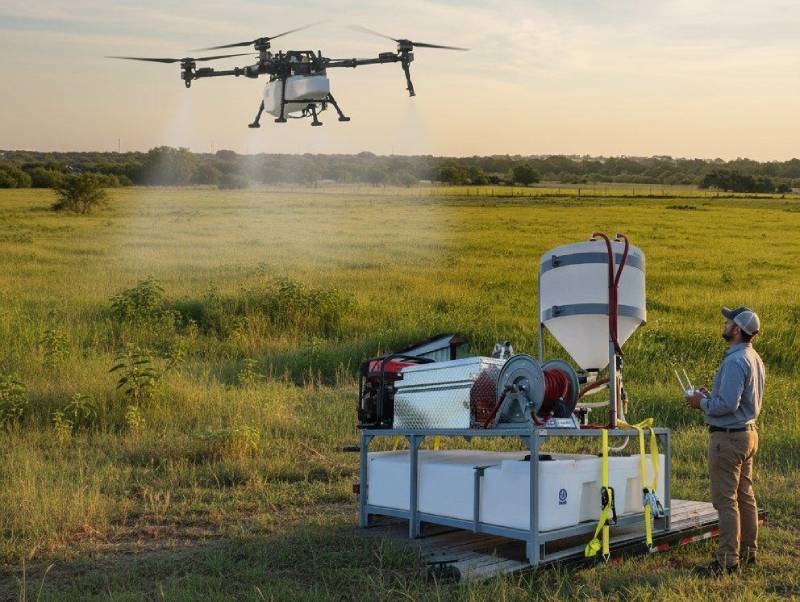
Modern spray drones can use GNSS/RTK positioning, terrain-following radar, adjustable droplet sizes, and automated flight paths. Higher Ground Aerial currently lists the DJI Agras T40 in its equipment lineup, with GNSS/RTK positioning, terrain-following radar, adjustable spray droplets, and a listed 30-foot swath.
These capabilities can help operators deliver consistent applications across challenging landscapes.
The objective isn’t simply to cover more acres.
It’s to apply the right treatment to the right area with greater precision.
What Happens During an Aerial Vegetation Management Project?
A professional project typically begins with understanding the property and its management goals.
Higher Ground Aerial describes its process as:
- Understanding the property’s vegetation challenges
- Performing aerial mapping and site assessment
- Deploying drones for targeted treatment
- Providing reporting and project results
This approach helps ensure that treatment decisions are connected to the actual conditions on the property.
Is Aerial Vegetation Management Right for Your Property?
If your land has expanding brush, invasive vegetation, difficult terrain, wildlife-management challenges, or vegetation affecting infrastructure, aerial treatment may be worth evaluating.
It can be especially useful for:
- Large ranches
- Wildlife properties
- Watersheds
- Dams and levees
- Aquatic environments
- Difficult terrain
- Forestry and brush-management projects
- Infrastructure corridors
Higher Ground Aerial provides aerial land and wildlife management services across Texas and Oklahoma, with a focus on precision vegetation control and minimizing ground disturbance.
Final Thoughts
Vegetation management is most effective when it starts with a clear understanding of the land.
If brush is spreading, wildlife habitat is becoming unbalanced, difficult terrain is preventing access, or vegetation is creating problems around waterways and infrastructure, it may be time to evaluate a more targeted management strategy.
Aerial vegetation management isn’t a replacement for every traditional land-management method. Instead, it gives Texas landowners another tool for addressing vegetation challenges—particularly where precision, access, and minimal ground disturbance matter.
If you’re unsure whether aerial treatment is appropriate for your property, the best place to start is with a professional assessment.
Higher Ground Aerial provides precision aerial vegetation management and wildlife habitat solutions for Texas and Oklahoma properties. Contact the team to discuss your land-management goals and request a customized quote.
Frequently Asked Questions
What is aerial vegetation management?
Aerial vegetation management uses aircraft or drones to monitor, treat, or manage unwanted vegetation. Spray drones can provide targeted applications in areas that may be difficult to access with traditional ground equipment.
Is drone vegetation management suitable for large Texas ranches?
Yes. Drone-based vegetation management can be particularly useful on large properties where terrain, distance, or environmental sensitivity makes conventional equipment difficult to use.
Can drones be used for brush control?
Yes. Spray drones can be used for certain brush-management applications when the treatment, product, operator qualifications, site conditions, and applicable requirements are appropriate.
Can drone vegetation management help wildlife habitat?
It can. The objective of habitat management is often to create an appropriate balance of food, cover, and open areas rather than simply remove vegetation. Texas A&M AgriLife Extension notes that brush can provide important wildlife cover while excessive brush can reduce forage availability, making treatment patterns and land objectives important.
Can drones treat vegetation around ponds and waterways?
Specialized spray drones can be used for certain aquatic vegetation-management projects. However, each application must follow applicable product-label requirements and regulatory restrictions.
How much does aerial vegetation management cost?
Pricing depends on acreage, vegetation density, terrain, treatment requirements, travel, and the specific management objective. A property assessment is the best way to determine project-specific pricing.