Managing vegetation across large properties in Texas has always been a major investment for landowners, ranchers, and wildlife managers. Whether it’s controlling invasive species, restoring pasture, or maintaining waterways, choosing the right method can significantly impact both cost and land health.
Today, many property owners are asking:
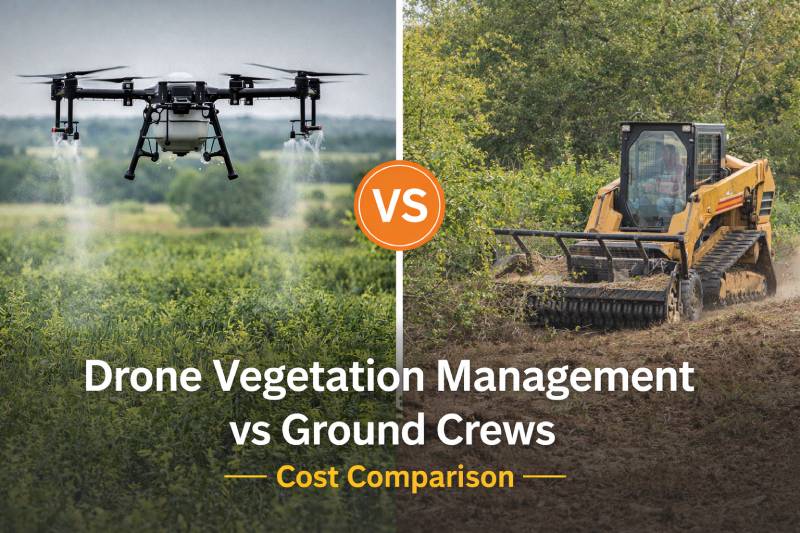
Is drone vegetation management more cost-effective than traditional ground crews?
In this real-world comparison, we break down accurate per-acre costs, performance differences, and long-term value—so you can make the best decision for your land.
Understanding Traditional Mechanical Vegetation Management Costs
Traditional vegetation control relies on heavy equipment such as tractors, skid steers, mulchers, and ground spraying systems. While effective in some situations, these methods come with significantly higher costs and environmental impact.
Cost Per Acre Breakdown
Mechanical vegetation management in Texas typically starts at:
- $600–$800 per acre (low-end)
- $800–$1,000+ per acre (common range)
- $1,000+ per acre for specialized work
For example:
- Dam vegetation removal
- Dense brush clearing
- Hard-to-access terrain
These projects often require specialized equipment and additional labor, driving costs even higher.
Why Costs Increase Quickly
Several factors push mechanical costs upward:
- Heavy equipment transportation
- Fuel consumption
- Labor-intensive operations
- Terrain difficulty
- Equipment wear and maintenance
Additionally, mechanical clearing often treats entire areas rather than targeting specific problem zones, increasing overall cost per acre.
What Is Drone Vegetation Management?
Drone vegetation management uses advanced aerial technology to apply treatments precisely where they are needed.
Instead of clearing or spraying entire sections of land, drones:
- Target invasive species directly
- Reduce chemical usage
- Avoid damaging surrounding vegetation
- Access difficult or sensitive areas
At Higher Ground, our Aerial Vegetation Management in Texas focuses on precision, efficiency, and long-term land sustainability.
Drone Vegetation Management Cost Per Acre in Texas
Drone-based vegetation control offers a significantly more efficient pricing model.
- Average cost: Around $250 per acre
This pricing includes:
- Precision aerial application
- Minimal chemical waste
- No heavy equipment use
- Faster job completion
Compared to traditional methods, this represents a substantial reduction in cost—especially for large acreage.
Real-World Cost Comparison: Drone vs Ground Crews
| Factor | Drone Vegetation Management | Mechanical Ground Crews |
|---|---|---|
| Cost Per Acre | ~$250 | $600–$1,000+ |
| Land Impact | Non-destructive | High disturbance |
| Precision | Highly targeted | Broad application |
| Terrain Access | Excellent | Limited |
| Speed | Fast | Slower |
| Environmental Impact | Low | Moderate to High |
In many cases, drone solutions reduce costs by 50–70% per acre, while delivering better precision and less environmental damage.
Why Drone Solutions Are More Cost-Efficient
The cost advantage of drone technology comes from efficiency and precision.
1. Targeted Application
Drones only treat problem areas instead of entire sections, reducing material usage.
2. No Heavy Equipment Costs
Eliminates fuel, transport, and maintenance expenses associated with machinery.
3. Reduced Labor Requirements
A small, skilled team replaces large ground crews.
4. Faster Project Completion
Large areas can be treated quickly, reducing total project timelines.
When Traditional Methods May Still Be Used
While drone technology offers clear advantages, mechanical methods may still be used in specific cases:
- Large-scale land clearing projects
- Tree removal requiring physical equipment
- Initial site preparation for development
However, for vegetation control, maintenance, and habitat management, aerial solutions are often the more efficient choice.
Why Texas Landowners Are Switching to Aerial Solutions
Across Texas, ranchers and property owners are shifting toward drone-based management because it offers:
- Lower per-acre costs
- Minimal land disturbance
- Better long-term land health
- Improved wildlife habitat protection
Our brush control services for ranches are designed specifically to help landowners maintain productivity without damaging soil or ecosystems.
Additionally, our wildlife habitat management solutions support sustainable land practices while enhancing biodiversity.
Final Verdict: Which Option Is Right for Your Property?
If your goal is:
✔ Cost efficiency
✔ Precision vegetation control
✔ Environmental sustainability
✔ Minimal land disruption
Then drone vegetation management is the clear winner for most Texas properties.
With average costs around $250 per acre, compared to $600–$1,000+ per acre for mechanical methods, aerial solutions provide both immediate savings and long-term value.
For a customized quote based on your land, visit our Contact Page and request a consultation.
Frequently Asked Questions
Drone vegetation management typically costs around $250 per acre, depending on terrain, vegetation density, and project size.
In many cases, yes — especially for large acreage or hard-to-reach land.
Mechanical vegetation management generally ranges from $600 to $1,000+ per acre, depending on complexity and equipment required.
Yes. Drone-based solutions are non-destructive, reduce chemical usage, and minimize soil disturbance.
Absolutely. Drone technology is ideal for large acreage, uneven terrain, and sensitive wildlife habitats.
Read More: Why Aerial Mapping Is Essential for Wildlife Habitat Planning